

Before Heavy Development: How Land Investment Can Hedge Risk First
- By dream-domes.com
“
Snapshot:
For land investors evaluating capital commitment timing
The biggest risk in land investment is not return volatility, but irreversible decisions made too early.
Traditional heavy development concentrates uncertainty at the point of highest capital exposure.
Lightweight, reversible hospitality models such as glamping can act as a risk-hedging layer, not a final build.
Early-stage cash flow functions as market validation, not profit optimization.
The objective is to delay irreversibility while improving decision quality.

In today’s land investment environment, one question matters more than most others: When is the right moment to commit serious capital to development?
If you own—or are considering acquiring—5 to 50 acres of non-urban land, you already understand that land investment is not just about upside.
It is about timing, risk mitigation, and decision quality.
The challenge is not whether land can generate returns. The challenge is how to reduce irreversible risk before committing to capital-intensive assets.
This article explores how modern land investors are rethinking development order—and why lightweight, reversible hospitality models such as glamping are increasingly used as a risk-hedging layer rather than a final destination.
The Real Risk in Land Investment Is Not Uncertain Returns It’s Committing Too Early
Most underperforming land investments do not fail because demand disappears.
They fail because decisions were locked in before the market was truly understood.
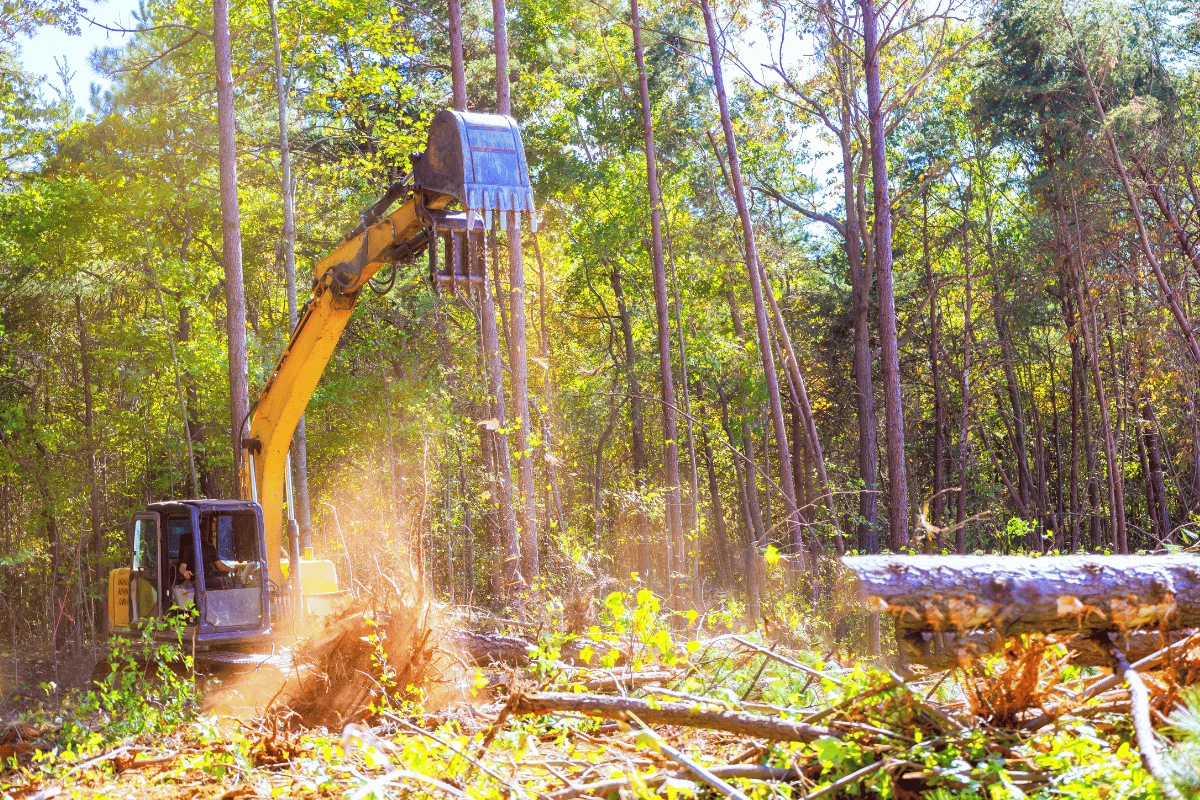
Traditional land development follows a familiar sequence:
1
Planning
2
Design
3
Permitting
4
Heavy Infrastructure
5
Long Holding Period
6
Cash Flow
The issue with this model is not that it cannot work. It is that it concentrates risk at the very beginning.
You are forced to:
- Commit large amounts of capital upfront
- Lock in a development concept based on projections.
- Accept high sunk costs before receiving real market feedback.
Once capital-intensive infrastructure is in place, flexibility disappears.
At that point, even a flawed strategy must be “worked through” rather than corrected.
From a land investment perspective, this is not risk management—it is risk front-loading.
What “Risk Hedging” Really Means in Modern Land Investment
In financial markets, risk hedging often refers to interest rates, currency exposure, or insurance instruments.
In land investment, the most critical risk is different.
It is decision risk.
Specifically:
Making irreversible development decisions before demand, pricing, and use patterns are validated. Risk hedging in this context does not mean avoiding risk entirely.
It means reducing the cost of being wrong.
The goal is simple:
-
Delay irreversible commitments
-
Gather real operational data
-
Preserve optionality as long as possible
This mindset has become increasingly important as land investment timelines stretch and uncertainty rises.
Why Early Cash Flow Is a Hedging Tool—Not a Profit Shortcut You may be thinking:
You may be thinking:“Generating income before development sounds practical—but isn’t that just running a small business on the land?”
The distinction lies in intent.
Early-stage cash flow, when used correctly, is not about maximizing profit.
It is about market validation. Think of it as a Minimum Viable Product (MVP) for land use:
At what price point?
Are guests willing to pay for this location?
In which seasons?
For which type of experience?
This information is far more valuable than speculative feasibility studies.
In this sense, early cash flow functions as:
A demand test
A pricing calibration tool
A behavioral insight engine
It turns assumptions into evidence—before capital becomes locked in.

Why Reversible, Light-Asset Models Are Effective Risk Mitigation Tools
Across Europe and North America, more land investors are using glamping and luxury camping as a strategic layer in land investment—not as a final outcome.
Why? Because these models align perfectly with modern risk mitigation principles.
They offer: This improves capital efficiency and protects liquidity.
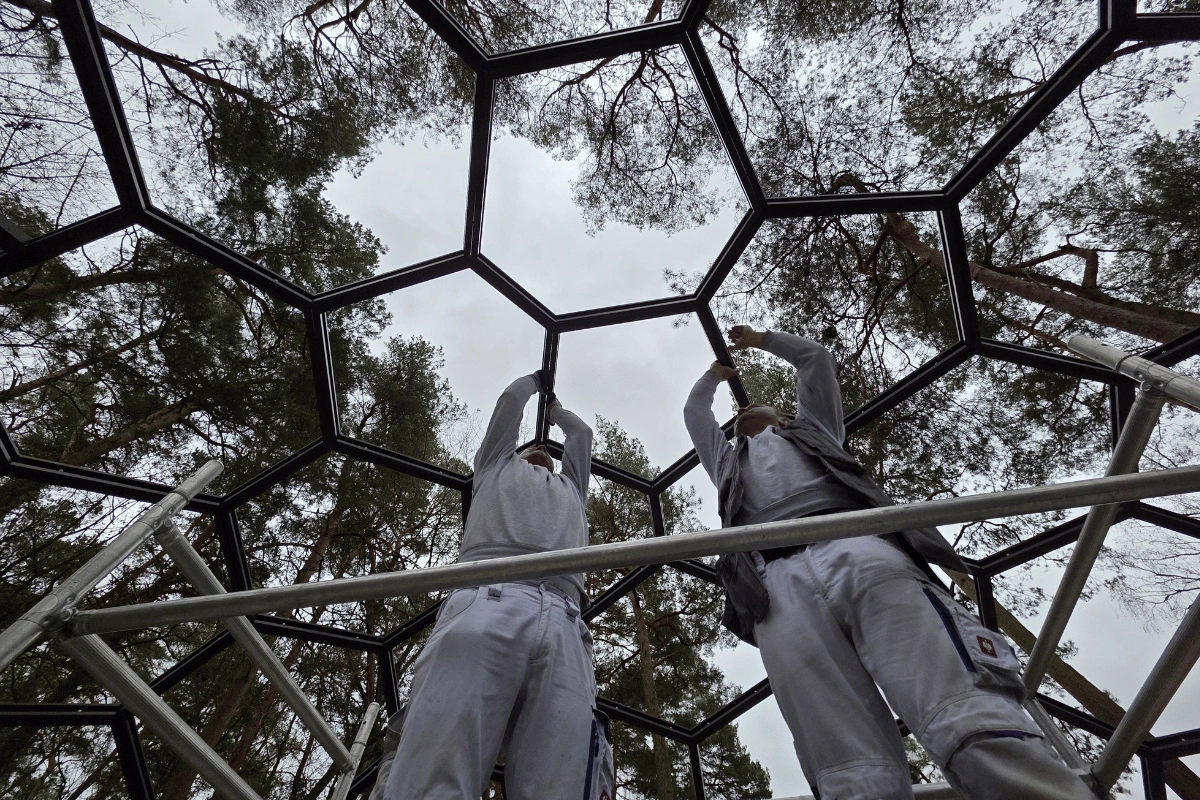
A glamping dome or geodome is not permanent infrastructure.
Reversibility means:
- You can relocate units
- Adjust layouts
- Scale up or down without structural loss
This flexibility is rare in traditional hospitality business development.
Permitting timelines are often shorter. Time-to-market is measured in months, not years.
Speed matters when validating land investment assumptions. You are not guessing how guests behave—you are observing it. Occupancy patterns, length of stay, seasonality, and price sensitivity become visible quickly.
From an investment standpoint, these structures are not the asset—they are the diagnostic instrument.
Glamping as a Risk-Hedging Layer, Not a Final Commitment
A common misconception is that lightweight hospitality equals temporary or low-quality development.
That is not how professional investors view it.
When positioned correctly, glamping and luxury camping serve as a first development layer:
Not “Should I build a resort?”
But “How does this land perform when activated?”
Some parcels demonstrate clear potential for expansion into capital-intensive hospitality assets.
Others reveal that low-density, high-margin experiences outperform large-scale builds.
The advantage lies in choice.
By using reversible structures first, land investment decisions are made with evidence—not hope.

A Practical, Investor-Oriented Implementation Framework
If you are considering this approach, the process does not need to be complex.
step 1
Is it demand uncertainty? Pricing risk? Development direction?
Is it demand uncertainty? Pricing risk? Development direction?
step 1
step 2
Deploy a Small, Controlled Activation
A limited number of glamping dome or geodesic dome units is sufficient.
The goal is learning—not scale.
step 2
step 3
Observe Before Optimizing
Revenue matters—but patterns matter more.
Who books? When? Why?
step 3
step 4
Decide on Heavy Infrastructure Later
At this point, you are no longer speculating.
You are allocating capital with context.
step 4
This approach supports asset diversification, protects downside exposure, and opens paths to passive income without premature commitment.
The Smartest Hedge in Land Investment Is Delaying Irreversibility
In today’s land investment landscape, capital is not the scarcest resource.
Clarity is.
By using lightweight, reversible hospitality models such as glamping to activate land early, you gain:
-
Market validation
-
Strategic flexibility
-
Stronger decision-making leverage
Whether you ultimately expand, refine, or exit, you do so from a position of strength.
This is not hesitation.It is professional risk management.
And for modern land investors, that discipline often defines the difference between optionality and obligation.
Share the Post: